AI Search Is Shifting: Where You Should Optimize in 2026
16 Jul, 2026



Search visibility is no longer limited to where your website ranks on Google.
Today, people ask AI platforms to compare products, recommend service providers, explain complex topics, and identify the best options for specific needs. In many of these journeys, users may receive an answer before they visit a traditional list of search results. This creates a new question for brands: How often does AI mention your business when customers ask relevant questions?
The answer is closely connected to AI Share of Voice.
As AI-driven search becomes part of how people discover and evaluate brands, understanding this metric can help businesses measure visibility beyond rankings, traffic, and keyword positions.
AI Share of Voice measures how visible a brand is across AI-generated responses compared with competing brands.
In practical terms, it looks at how frequently your brand is mentioned, recommended, cited, or included when users ask AI platforms questions related to your industry, products, or services.
For example, imagine users asking AI platforms questions such as:
- What are the best digital marketing agencies in India?
- Which companies provide AI SEO solutions?
- What should businesses consider when choosing an SEO partner?
If the same competitor consistently appears in responses while your brand is rarely mentioned, that competitor has a stronger AI Share of Voice for those topics.
Unlike traditional SEO, this visibility is not always represented by a single ranking position. A brand may rank highly for a keyword and still receive limited visibility in AI-generated answers if AI systems do not frequently select, reference, or associate the brand with the topic being discussed.
That makes AI Share of Voice an increasingly useful way to understand brand visibility across changing search experiences.
Keyword rankings remain important, but they only show part of how customers discover information.
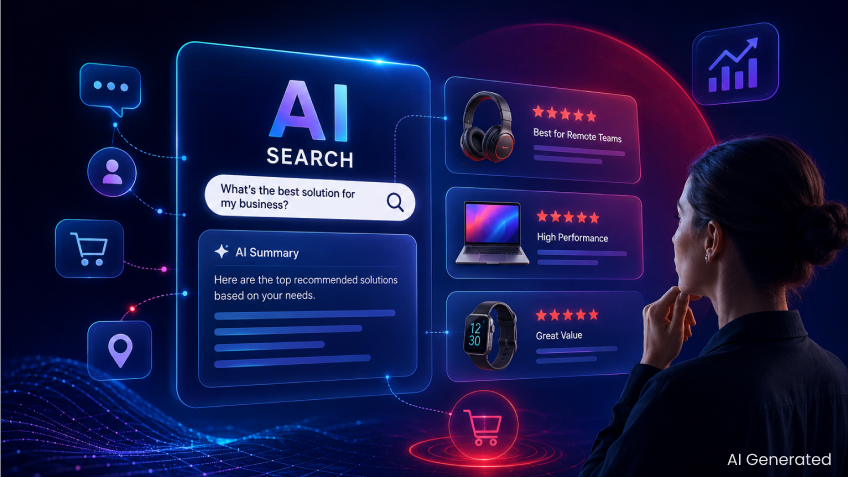
AI search experiences can summarise information from multiple sources, compare options, and introduce users to brands they may not have searched for directly. A user looking for “the best solution” may receive several recommendations based on a broader question rather than clicking through ten individual search results.
This means businesses need to consider two different forms of visibility:
- Search visibility: Where your pages appear in traditional organic search results.
- AI visibility: How frequently your brand or content appears in AI-generated responses.
The two can overlap, but they are not always identical.
A page with strong rankings may not always be referenced in AI responses. At the same time, a brand with a well-established reputation and clear topical authority may appear in AI-generated recommendations even when it is not ranking first for every related keyword.
This is why working with a strategic SEO company in India increasingly requires looking beyond keyword positions alone.
There is no single optimisation tactic that guarantees a brand will appear in AI-generated responses. However, several factors can influence how easily a brand and its information can be understood across search and AI environments.
Brands that consistently publish useful information around a specific subject can create stronger associations with that topic.
Rather than producing unrelated content across dozens of categories, businesses can develop clusters of blogs, service pages, guides, case studies, FAQs, and expert insights around areas where they want to build authority.
AI systems depend on available information to generate responses. Conflicting, outdated, vague, or poorly structured information can make it harder for systems and users to understand what a business actually offers.
Clear service descriptions, accurate company information, well-organised website content, and consistent messaging can strengthen a brand's overall digital presence.
A brand's website is not the only source contributing to its online visibility.
Industry publications, reputable websites, reviews, directories, expert discussions, and other relevant third-party mentions can all help establish a broader digital footprint. The objective is not simply to gain mentions everywhere but to build credible visibility in places relevant to the industry and audience.
Generic content is becoming easier than ever to produce. As a result, information that includes original research, practical experience, expert insight, unique data, or detailed analysis can provide greater value than content that simply repeats widely available information.
Businesses investing in AI SEO services in India should focus on creating information worth referencing rather than publishing content solely to increase volume.
AI visibility can influence brand awareness before a potential customer reaches your website.
When a brand is repeatedly mentioned in relevant discussions, comparisons, and recommendations, it has more opportunities to enter the customer's consideration set. Even when users do not click immediately, repeated exposure can contribute to familiarity and future branded searches.
AI Share of Voice can also reveal competitive gaps.
For example, a business may discover that competitors dominate conversations around specific customer questions despite having similar traditional search rankings. This can highlight opportunities to improve topical coverage, strengthen brand authority, update existing content, or develop clearer resources around important subjects.
For this reason, an experienced SEO company in India should increasingly assess where a brand appears across AI-driven discovery alongside conventional organic performance.
Measurement should begin with the questions that matter to your customers.
Businesses can create a set of relevant prompts covering product discovery, service comparisons, industry problems, and purchase decisions. They can then analyse which brands are consistently mentioned across relevant AI platforms.
Useful indicators include:
- Frequency of brand mentions
- Number of relevant prompts where the brand appears
- Competitor mention frequency
- Citation or source visibility where available
- Brand sentiment and context of mentions
- Changes in visibility over time
The goal is not simply to achieve the highest number of mentions. A brand should aim to appear in conversations that are genuinely relevant to its products, expertise, and commercial objectives.
The growth of AI search is expanding the definition of what it means to be visible online.
Businesses can no longer rely exclusively on rankings and traffic to understand their digital presence. They also need to consider whether AI systems recognise their expertise, understand their offerings, and surface their brand in relevant conversations.
Investing in AI SEO services in India can help businesses identify these emerging visibility gaps and strengthen the content, authority, and digital signals that support long-term discovery.
AI Share of Voice is ultimately not about replacing SEO. It is about gaining a broader understanding of how your brand competes as search becomes increasingly conversational, summarised, and AI-driven.
Brands should track the AI platforms their target audience uses for research, recommendations, comparisons, and product or service discovery.
Monthly or quarterly tracking can help businesses identify meaningful changes in brand visibility and competitor presence over time.
Yes, new brands can gradually improve visibility by building credible online mentions, publishing useful information, and establishing expertise around relevant topics.
With strategy and insights at the core, we seamlessly integrate creative, technology, video, SEO, and performance marketing to deliver projects on time and within budget. That's why clients of all sizes and industries trust us for their most diverse and dynamic needs.



















We combine the agility of a mid-sized agency with the strategic depth of a consulting partner. Every project starts with a business lens - focused on outcomes, not just outputs.
In short, we are not just a digital agency. We are your digital growth partner.
We are all three - by design.
Our model is built to support modern business needs through integrated services across strategy, design, technology, and performance marketing. We help you define the problem, build the solution, and scale the impact.
We complement, not compete.
Think of us as your extended team - brought in for specific expertise, overflow capacity, or to scale faster. Whether it is UX strategy, campaign content, full-stack development, or performance marketing, we plug in where it matters most.
We work across markets and time zones.
Our teams are based in India, but we have delivered for clients in the Middle East, Europe, the US, Southeast Asia, and beyond. We adapt our workflows to suit your region, your rhythm, and your goals.
Simple - just reach out.
We will begin with a conversation to understand your needs and identify how we can support you. From there, we tailor the right approach - whether it is a quick sprint or a long-term roadmap.
© 2026 All Rights Reserved