AI Search Is Shifting: Where You Should Optimize in 2026
16 Jul, 2026

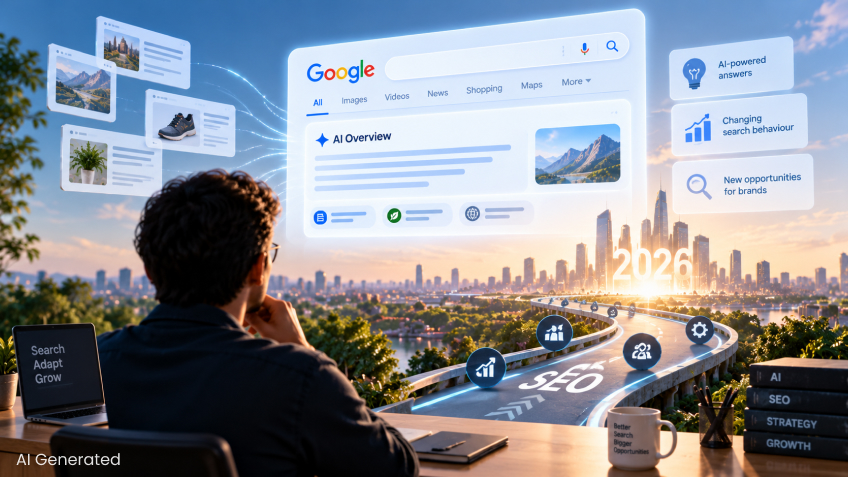


Google Search is changing and changing fast. Instead of simply displaying search, results are increasingly led by AI-generated summaries that answer users questions before they even visit a website. For years, the basic equation was simple: search for something, scan the results, click on a website and find the answer. That equation is now evolving. With Google increasingly putting AI-generated summaries at the top of search results, users can often get a fairly complete answer without clicking through to multiple websites.
According to an Ahrefs analysis of 300,000 keywords, pages ranking first on Google experience an average 58% lower click-through rate (CTR) on searches featuring AI overviews compared to similar queries without them. However, research highlighted by Search Engine Land and Seer Interactive also found that pages cited inside AI-generated summaries receive more than twice the clicks of uncited pages on the same search results.
The takeaway is clear: ranking first still matters, but in 2026, being referenced inside Google AI Overviews has become equally important.
Traditional SEO was built around one objective—earning clicks.
Nowadays, users will get full answers in the search results. They won't need to visit several websites to get a sense of information; instead, they will be able to read an AI-generated summary that amalgamates the information from multiple trusted websites.
This change is causing a decrease in traffic for lots of informational queries, and favoring sites that regularly prove to be knowledgeable, trustworthy, and authoritative in a given field.
Generative Engine Optimization (GEO) is one of the most significant changes in strategy for 2026. The key difference between traditional SEO and GEO is that GEO is not solely about ranking but also about helping the AI models to better understand, synthesize, and reference the content in generating answers.
The content is becoming more and more structured with clear answer boxes, topical authority, structured data, and authoritative references for businesses investing in AI SEO services to ensure that AI systems can confidently surface their information.
The goal is no longer to be a place to get ranked; it's now to be a place to get the answer.
Google's AI algorithms look at more than just keywords.
They evaluate the quality of the content based on its expertise, information reliability, thorough answers, and adherence to the user's query. A website that regularly provides in-depth, relevant content throughout a topic is more likely to be a trusted source of citations.
So, it is possible that the 10 individual blogs you publish monthly are not as effective as creating a rich content asset surrounding your central topic.
To brands, authority is more of a competitive edge than rankings.
Traffic and keyword rankings still matter—but they no longer tell the complete story.
As AI-generated answers become more common, businesses should also monitor metrics that reflect visibility within AI-powered search experiences.
Consider tracking:
These indicators provide a clearer understanding of how customers discover and interact with your brand in an AI-first search landscape.
You do not need to give up on traditional SEO when it comes to adapting to AI-powered search. Rather, companies need to adapt their content approaches to cater to human users and AI systems.
AI summaries focus on summarizing the information in a clear and direct manner. Use a brief explanation in key paragraphs near the start of the text; structure text with descriptive headings, bullets and short summaries. This allows for better understanding of the content by readers and AI models.
AI systems are more likely to cite content backed by trustworthy research, up-to-date statistics, expert quotes, and original insights. Don't write generic articles, but rather resources that are valuable and show subject matter expertise.
The use of schema markup is still very significant for search engines to understand content. The implementation of Article, FAQ, Organization, and HowTo schema will not only make the content easier to read by machines, but it will also enable better discovery via AI.
AI's overwhelming volume of information makes businesses more focused than ever on rank, but they should now track when it appears in AI answers, as well as how it is cited and whether this in turn drives branded search and engagement.
With the evolution of informational search, it's more about business impact, not just traffic. When fewer but more targeted visitors are coming in via search, optimizing landing pages, Uber calls to action and conversion journeys are even more critical.
| Traditional SEO | AI-First SEO |
|---|---|
| Focuses primarily on rankings | Focuses on rankings and AI citations |
| Keyword optimization | Topic and entity optimization |
| Measures success through traffic | Measures authority, citations, and engagement |
| Optimizes for search crawlers | Optimizes for users and AI models |
| Clicks are the primary KPI | Visibility, trust, and conversions matter equally |
Search is becoming more conversational, more personal and more AI. With continued optimization for ranking, businesses can still lose visibility even with good rankings in traditional search results.
Companies that are investing in an AI SEO company are anticipating this transformation by producing authoritative, structured, and evidence-based material that is effective in typical and AI-driven search results.
As Google AI Overviews grow in scope and scale, from information-heavy queries to commercial ones, it's not just the top-ranked brands that will win—the brands Google's AI believes are worthy of recommendation will get the attention.
Google AI Overviews are changing how users discover information and how businesses earn organic visibility. Learn why rankings alone are no longer enough and explore practical SEO strategies for succeeding in AI-driven search.
Yes. Strong rankings don't guarantee inclusion. AI Overviews prioritize content that demonstrates authority, relevance, and clear answers to user queries.
High-value pages should be reviewed regularly to keep statistics, examples, and industry insights current, improving their chances of being cited in AI-generated responses.
No. AI-first SEO builds on traditional SEO by adding greater emphasis on structured content, topical authority, and machine-readable information that AI systems can interpret.
With strategy and insights at the core, we seamlessly integrate creative, technology, video, SEO, and performance marketing to deliver projects on time and within budget. That's why clients of all sizes and industries trust us for their most diverse and dynamic needs.



















We combine the agility of a mid-sized agency with the strategic depth of a consulting partner. Every project starts with a business lens - focused on outcomes, not just outputs.
In short, we are not just a digital agency. We are your digital growth partner.
We are all three - by design.
Our model is built to support modern business needs through integrated services across strategy, design, technology, and performance marketing. We help you define the problem, build the solution, and scale the impact.
We complement, not compete.
Think of us as your extended team - brought in for specific expertise, overflow capacity, or to scale faster. Whether it is UX strategy, campaign content, full-stack development, or performance marketing, we plug in where it matters most.
We work across markets and time zones.
Our teams are based in India, but we have delivered for clients in the Middle East, Europe, the US, Southeast Asia, and beyond. We adapt our workflows to suit your region, your rhythm, and your goals.
Simple - just reach out.
We will begin with a conversation to understand your needs and identify how we can support you. From there, we tailor the right approach - whether it is a quick sprint or a long-term roadmap.
© 2026 All Rights Reserved
