AI Share of Voice: What It Is and Why It Matters for Your Brand
11 Sep, 2026

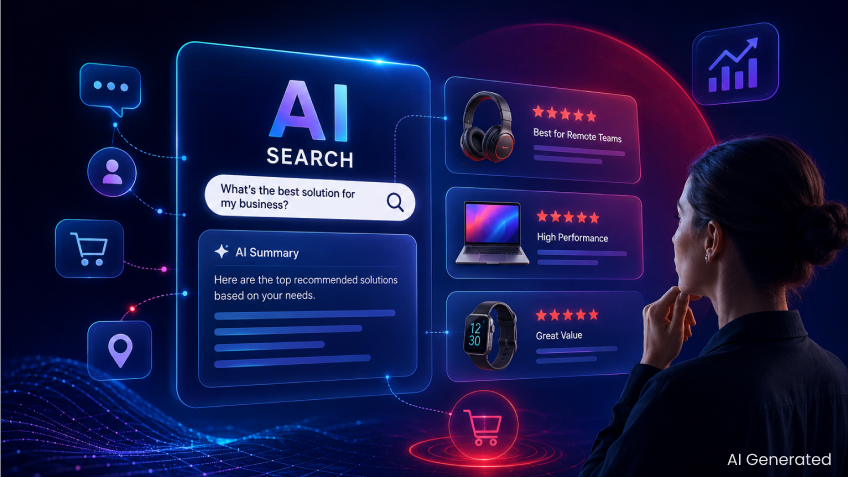


Search behavior is changing faster than ever. Instead of comparing multiple websites, consumers are increasingly asking AI assistants for direct recommendations, product comparisons, and personalized answers. According to McKinsey, nearly half of consumers already use AI-powered search, and it could influence around $750 billion in consumer spending by 2028. This shift is redefining how people discover, evaluate, and choose brands.
For businesses, this means visibility is no longer limited to ranking on the first page of search results. Brands must also create content that AI systems can understand, trust, and confidently recommend. As AI-powered search becomes a larger part of the customer's journey, understanding how it influences consumer behavior is becoming essential for long-term digital success.
In the past, people used to search using short keywords for the information they needed, and often, had to visit multiple websites to find the information.
Today, consumers ask conversational questions such as, "Which CRM is best for a startup?" or "Which project management software is most affordable for remote teams?" AI systems analyze intent, compare information from multiple sources, and generate responses that save users time and effort.
With this change, brands have to develop content that responds to actual customer queries rather than just keywords.
AI-generated summaries have impacted consumer judgment of businesses. Rather than comparing several websites, people can get recommendations on products, feature comparisons, and purchase advice through AI-generated searches. Users can get product or service suggestions, comparisons, and purchasing advice directly into their AI-powered search experiences, without having to click through multiple websites.
This means that a brand’s reputation may be affected before a potential customer visits its website. Businesses that have structured, reliable, and accurate content will be visible in AI responses at the initial stages of the consumer journey.
Contextual signals, location, past interactions, and search intent are all increasingly taken into account by AI systems when considering what recommendations to make. This means if two users are looking for the same product, they can get different answers based on their needs and preferences.
Brands should therefore make content that addresses several customer scenarios, several buying phases and use cases – and not generic messaging.
While having a high position in search engine results pages is still important, it is no longer the only metric for visibility. AI systems increasingly summarize information from trusted sources, and brands need to gain recognition by delivering quality, relevant, and credible content.
Creating comprehensive resources helps improve the chances of being surfaced in AI-generated responses as well as traditional search results.
AI systems are more likely to cite brands with consistent content that provides accurate, helpful, and timely information across the web.
Rather than creating content solely for ranking, businesses should prioritize showing their expertise, answering customer inquiries, and ensuring factual correctness. To build authority-driven content strategies and aligned with the evolving search experience, many organizations partner with an experienced AI SEO agency.
Modern content should answer the consumer’s question naturally while also giving explanations, examples, and insight into the topics.
Instead of having separate pages for each keyword, businesses should create in-depth resources that address the topic from several perspectives.
By publishing relevant blogs, FAQ pages, case studies, services, and industry-related information, it helps search engines and AI to understand the brand's expertise.
Strong topical authority also improves discoverability across both traditional search engines and AI-powered search experiences.
AI systems are increasingly focused on information that is relevant to current trends and recent developments, and that comes from reliable sources.
The more current the statistics, examples, case studies, and industry insights, the more likely they are to be credible and relevant to the content that is recommended by AI.
A lot of companies hire a professional AI SEO agency to audit, revamp, and optimize their current web content for search engines and AI-powered discovery
The future of search will be driven more by conversations than keywords alone. As consumers rely more on AI assistants to research products, compare services, and make purchasing decisions, brands must adapt their content strategies accordingly.
Businesses that invest in AI-powered search optimization by creating authoritative, user-focused, and trustworthy content will be better positioned to remain visible across both traditional search engines and emerging AI-driven experiences.
AI-powered search is reshaping how consumers discover information and make purchasing decisions. Brands that focus on trustworthy, user-focused, and authoritative content will be better positioned to earn visibility in both traditional search results and AI-generated recommendations.
AI-powered search helps consumers compare products, evaluate options, and access summarized information quickly, allowing them to make more informed buying decisions.
Yes. Traditional SEO remains important, but businesses should also focus on creating authoritative, well-structured content that AI systems can interpret and recommend.
Brands should publish helpful, up-to-date content, strengthen topical authority, and regularly optimize their websites to align with evolving AI-driven search experiences.
With strategy and insights at the core, we seamlessly integrate creative, technology, video, SEO, and performance marketing to deliver projects on time and within budget. That's why clients of all sizes and industries trust us for their most diverse and dynamic needs.



















We combine the agility of a mid-sized agency with the strategic depth of a consulting partner. Every project starts with a business lens - focused on outcomes, not just outputs.
In short, we are not just a digital agency. We are your digital growth partner.
We are all three - by design.
Our model is built to support modern business needs through integrated services across strategy, design, technology, and performance marketing. We help you define the problem, build the solution, and scale the impact.
We complement, not compete.
Think of us as your extended team - brought in for specific expertise, overflow capacity, or to scale faster. Whether it is UX strategy, campaign content, full-stack development, or performance marketing, we plug in where it matters most.
We work across markets and time zones.
Our teams are based in India, but we have delivered for clients in the Middle East, Europe, the US, Southeast Asia, and beyond. We adapt our workflows to suit your region, your rhythm, and your goals.
Simple - just reach out.
We will begin with a conversation to understand your needs and identify how we can support you. From there, we tailor the right approach - whether it is a quick sprint or a long-term roadmap.
© 2026 All Rights Reserved