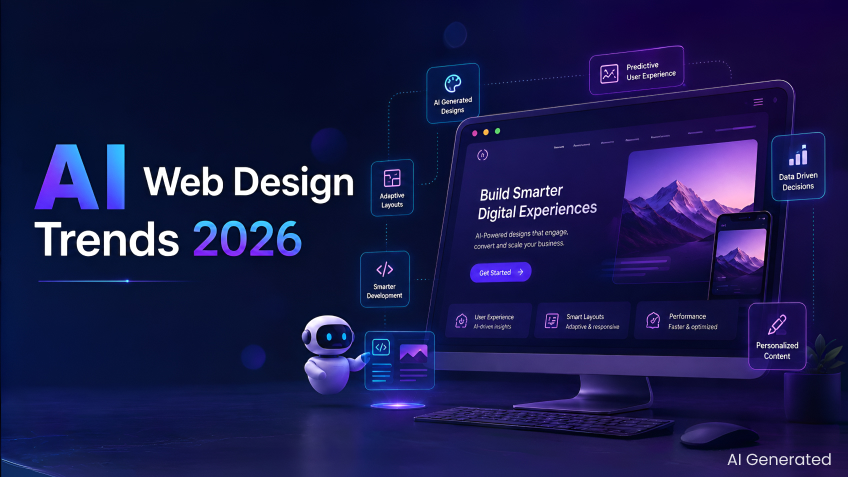
AI Web Design Trends 2026: What Businesses Need to Know
01 Jun, 2026



Artificial intelligence is no longer an experimental technology reserved for large enterprises. According to Gartner, generative AI has become the most widely deployed AI solution across organizations, signaling a shift from experimentation to enterprise adoption. Businesses are no longer asking whether they should invest in AI—they're asking how they can use it to create measurable competitive advantages.
While off-the-shelf AI tools can improve productivity, they often struggle to address organization-specific challenges, integrate with existing systems, or align with long-term business objectives. As a result, companies are increasingly investing in custom AI solutions that are built around their unique processes, data, and growth strategies. This growing demand has made partnering with an experienced AI development company in India a strategic priority for businesses looking to future-proof their operations.
Public AI platforms aim to be mass-market platforms that serve millions of users in a wide variety of businesses. They are convenient, but they usually don't know a company's proprietary data, internal processes, customer journey, or compliance needs.
Industry analysts are increasingly convinced that specialization is the key to enterprise AI's future. By 2027, three times more organizations will be using task-specific AI models than large language models, according to Gartner, which suggests that businesses will be more interested in solutions that are specific to the way they work.
With custom AI, you can develop an intelligent system that solves a specific business problem and is flexible enough to adapt to evolving business needs.
Today's businesses collect an incredible volume of customer and operational information. But if data is not turned into actionable insights, then it is not adding value.
Business-specific AI solutions use information to discern trends, predict demand, streamline processes, and aid in quicker decision-making. Instead of general advice, organizations get intelligence that is relevant to their operation.
Automation is not just for repetitive administrative tasks.
Custom AI can be used to automate customer support, process documents, manage inventory, aid in sales, and facilitate internal collaboration. These solutions are built on top of the business processes, resulting in more efficiency without having to redesign processes.
Additionally, the incorporation of website development services in businesses' AI transformation plans aims to facilitate the seamless integration of their websites and customer platforms with AI-enriched experiences and future digital advancements.
One of the greatest benefits of custom AI is that it can function with the present technology.
From CRM platforms and ERP systems to cloud infrastructure and in-house software, custom AI solutions can be seamlessly integrated into the business landscape, enhancing information flow and eliminating silos. This is a digitized environment that integrates a range of technologies, including AI, to boost productivity and not just to be a standalone solution.
Businesses need change, and technology needs to change as well.
Unlike pre-built software with limited functionality, custom AI solutions can be scaled to meet the increasing demands of customers, an expanding market, changing needs and operations, and new products as they are created. This flexibility ensures technology investments are protected and helps drive sustainable digital transformation.
With a reputable AI development firm in India, scalable solutions tailored to fit business growth are also provided.
Many organizations find that the challenge isn't just using AI; the key to a successful scale is the quality of the data.
Organizations that build robust data governance, next-generation data infrastructure, and integrated data ecosystems are much better suited to create long-term value from AI efforts, McKinsey says. Even sophisticated AI models fail to generate meaningful insights or accurate business data without proper, organized data.
This is why successful AI adoption often begins with strengthening data foundations before expanding AI across business functions.
Today's most successful companies don't perceive AI as a stand-alone project. Rather, they are integrating AI into customer engagement, operations, product innovation, marketing, and decision-making.
Businesses that understand the future of AI know that being competitive isn't about just installing AI—it is about being the business that owns AI solutions that align with their business expertise, processes and proprietary knowledge. To enhance digital experiences for customers, organizations also pair AI adoption with website development services, resulting in faster, smarter, and more personalized experiences.
The future of enterprise AI is becoming more personalized, integrated, and impactful to the bottom line. For businesses that are not aware of the developments in proprietary AI, the future might be tougher because they are unable to differentiate themselves from the competitors who are developing their AI tools.
By collaborating with a reliable AI development company in India, organizations can create intelligent, secure, and scalable AI solutions that cater to their long-term business goals. As AI evolves and transforms industries, custom solutions will play a pivotal role in driving innovation, operational efficiency, and sustainable competitive growth.
Businesses are increasingly investing in custom AI solutions to improve decision-making, automate workflows, and build long-term competitive advantages. Discover why tailored AI is becoming the foundation of modern digital transformation.
Custom AI solutions are built around an organization's unique data, workflows, and objectives, whereas public AI tools are designed for broad, general-purpose use.
Businesses should assess data readiness, integration requirements, scalability, security, and long-term business objectives before developing a custom AI solution.
Yes. Custom AI can be designed to align with industry regulations, data governance policies, and security standards across sectors such as healthcare, finance, and manufacturing.
Success is typically measured through improvements in operational efficiency, cost savings, decision-making speed, customer satisfaction, and return on investment (ROI).
With strategy and insights at the core, we seamlessly integrate creative, technology, video, SEO, and performance marketing to deliver projects on time and within budget. That's why clients of all sizes and industries trust us for their most diverse and dynamic needs.



















We combine the agility of a mid-sized agency with the strategic depth of a consulting partner. Every project starts with a business lens - focused on outcomes, not just outputs.
In short, we are not just a digital agency. We are your digital growth partner.
We are all three - by design.
Our model is built to support modern business needs through integrated services across strategy, design, technology, and performance marketing. We help you define the problem, build the solution, and scale the impact.
We complement, not compete.
Think of us as your extended team - brought in for specific expertise, overflow capacity, or to scale faster. Whether it is UX strategy, campaign content, full-stack development, or performance marketing, we plug in where it matters most.
We work across markets and time zones.
Our teams are based in India, but we have delivered for clients in the Middle East, Europe, the US, Southeast Asia, and beyond. We adapt our workflows to suit your region, your rhythm, and your goals.
Simple - just reach out.
We will begin with a conversation to understand your needs and identify how we can support you. From there, we tailor the right approach - whether it is a quick sprint or a long-term roadmap.
© 2026 All Rights Reserved
![Leading AI development companies in Delhi for Businesses to Consider [2026]](https://www.ninetriangles.com/uploads/images/Leading%20AI%20development%20companies%20in%20Delhi%20for%20Businesses%20to%20Consider-1.jpg.jpeg)