
Why Local SEO is Crucial for Your Business Growth
03 Jul, 2026

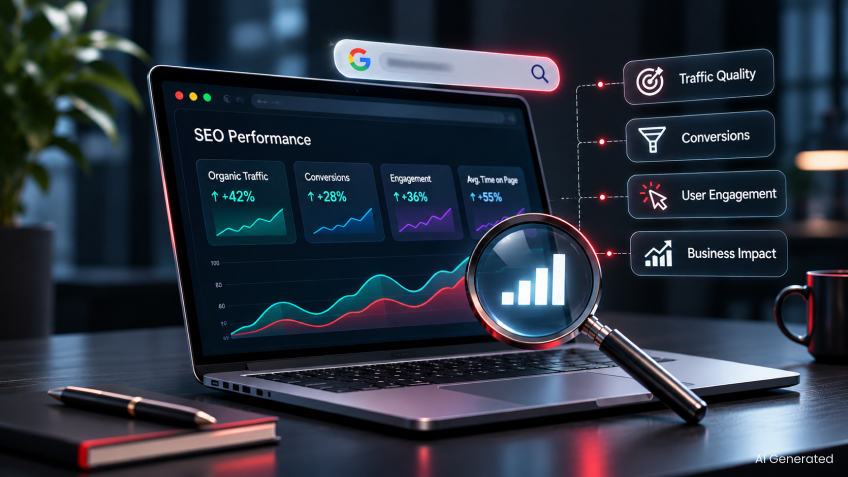


For years, SEO performance was judged using a simple question: Where does the website rank?
A move from position eight to position three was considered progress. Reaching the first position was often treated as the ultimate goal. Rankings still matter, but they no longer provide a complete picture of whether SEO is delivering business value.
Search results have changed. Users now encounter AI-generated answers, featured search experiences, videos, product listings, maps, and other elements before clicking a traditional organic result. A page can rank highly and still receive fewer clicks than expected. At the same time, a page with a lower ranking may generate valuable leads because it attracts users with stronger purchase intent.
For businesses, the focus must therefore shift from ranking visibility alone to meaningful performance outcomes.
Keyword rankings remain a useful indicator, but they should be viewed alongside impressions and overall search visibility.
For example, a page may maintain its ranking while impressions decline because search behaviour has changed. Another page may move down slightly but gain impressions as the total demand for the topic increases.
Google Search Console can help businesses analyse these changes by showing impressions, clicks, click-through rate, and search queries. Looking at these metrics together provides more context than monitoring ranking positions in isolation.
A strategic SEO company in India should therefore analyse whether a website is being discovered for relevant searches rather than simply reporting how many keywords rank in the top ten.
More traffic does not always mean better SEO performance.
A page attracting 10,000 visitors who leave without taking action may provide less business value than a page attracting 1,000 highly relevant visitors who request a quote, book a consultation, or purchase a product.
This makes traffic quality an important performance metric.
Businesses should analyse whether organic visitors:
- Spend time engaging with relevant content
- Visit additional pages
- Return to the website
- Complete important actions
- Move towards a purchase or enquiry
These signals help identify whether SEO is attracting the right audience rather than simply increasing visitor numbers.
Track Conversions and Micro-Conversions
The ultimate purpose of SEO is rarely to generate traffic alone.
Businesses should connect organic visibility with meaningful outcomes. Depending on the business model, primary conversions may include purchases, enquiries, demo requests, bookings, or qualified leads.
However, not every user converts during their first visit. This is where micro-conversions can provide additional insight.
Examples include:
- Downloading a resource
- Signing up for a newsletter
- Watching a product demonstration
- Using a calculator or interactive tool
- Clicking to contact the business
- Viewing important service or product pages
Tracking these actions helps businesses understand whether organic traffic is progressing through the customer journey.
An experienced SEO company in India should connect search performance with these outcomes to demonstrate where SEO is contributing to actual business growth.
Rankings are becoming less complete as a measurement because search visibility itself is expanding.
A brand may appear in AI-generated responses, summaries, comparisons, or recommendations even when users do not see a traditional ranking position in the same way. This makes it increasingly important to monitor how frequently a brand and its content appear across relevant AI-driven search experiences.
Businesses can begin by tracking high-value customer questions and analysing whether their brand is:
- Mentioned in AI-generated responses
- Cited as a source where citations are available
- Included in relevant recommendations or comparisons
- Appearing alongside key competitors
This is one reason AI SEO services in India are becoming part of broader search measurement strategies. Traditional ranking data alone cannot show every way customers discover a brand.
Not every page should be expected to generate an immediate conversion.
A research-focused article may introduce new users to a brand, while a comparison page may influence consideration. A service page may be designed primarily to generate enquiries.
SEO reporting should therefore evaluate pages according to their intended role.
Ask questions such as:
- Is this informational content increasing brand discovery?
- Is this comparison page helping users evaluate their options?
- Is this service page generating qualified leads?
Measuring every page against the same conversion target can make useful content appear unsuccessful. Intent-based measurement provides a clearer understanding of how different pages contribute to the wider customer journey.
SEO performance naturally changes over time.
Seasonality, changes in search demand, website updates, competitor activity, and evolving search features can all influence performance. A single month of data rarely explains the complete story.
Businesses should compare trends across meaningful periods and investigate the reasons behind major changes.
For example, declining clicks may require analysis of impressions, rankings, search features, and changes in user behaviour before concluding that SEO performance has weakened.
Teams using AI SEO services in India can also compare traditional search trends with changes in AI visibility to identify where discovery behaviour may be shifting.
The best SEO dashboards do not contain the most metrics. They contain the metrics that answer important business questions.
A practical framework should connect:
Visibility → Traffic quality → Engagement → Conversions → Business outcomes
This approach makes it easier to identify where performance is improving and where problems exist.
For example, high impressions but low clicks may indicate a visibility or messaging issue. Strong traffic but weak conversions may point towards search intent, content relevance, or user experience problems. Increasing conversions with stable traffic could indicate that the website is attracting more qualified users.
Keyword rankings remain valuable, particularly for tracking competitive visibility and identifying changes in search performance. However, they should no longer be treated as the final measure of SEO success.
As search journeys become more fragmented and AI-driven, businesses need to understand how visibility translates into meaningful action.
By measuring search visibility, traffic quality, engagement, conversions, and emerging AI discovery signals together, businesses can gain a more accurate picture of what their SEO investment is actually delivering.
SEO rankings alone no longer reveal the full picture of search performance. Learn how to measure SEO success through visibility, traffic quality, engagement, conversions, and AI-driven search discovery.
Monthly reviews are useful for tracking trends, while quarterly reviews can help assess broader business impact and long-term progress.
Yes, B2B businesses may prioritise qualified leads and longer conversion journeys, while B2C brands may focus more on transactions, revenue, and repeat purchases.
Yes, stable traffic can still deliver better results if the website attracts more qualified visitors and generates higher engagement, leads, or conversions.
With strategy and insights at the core, we seamlessly integrate creative, technology, video, SEO, and performance marketing to deliver projects on time and within budget. That's why clients of all sizes and industries trust us for their most diverse and dynamic needs.



















We combine the agility of a mid-sized agency with the strategic depth of a consulting partner. Every project starts with a business lens - focused on outcomes, not just outputs.
In short, we are not just a digital agency. We are your digital growth partner.
We are all three - by design.
Our model is built to support modern business needs through integrated services across strategy, design, technology, and performance marketing. We help you define the problem, build the solution, and scale the impact.
We complement, not compete.
Think of us as your extended team - brought in for specific expertise, overflow capacity, or to scale faster. Whether it is UX strategy, campaign content, full-stack development, or performance marketing, we plug in where it matters most.
We work across markets and time zones.
Our teams are based in India, but we have delivered for clients in the Middle East, Europe, the US, Southeast Asia, and beyond. We adapt our workflows to suit your region, your rhythm, and your goals.
Simple - just reach out.
We will begin with a conversation to understand your needs and identify how we can support you. From there, we tailor the right approach - whether it is a quick sprint or a long-term roadmap.
© 2026 All Rights Reserved
