How Content Syndication Can Drive More Traffic to Your Website
27 Dec, 2024

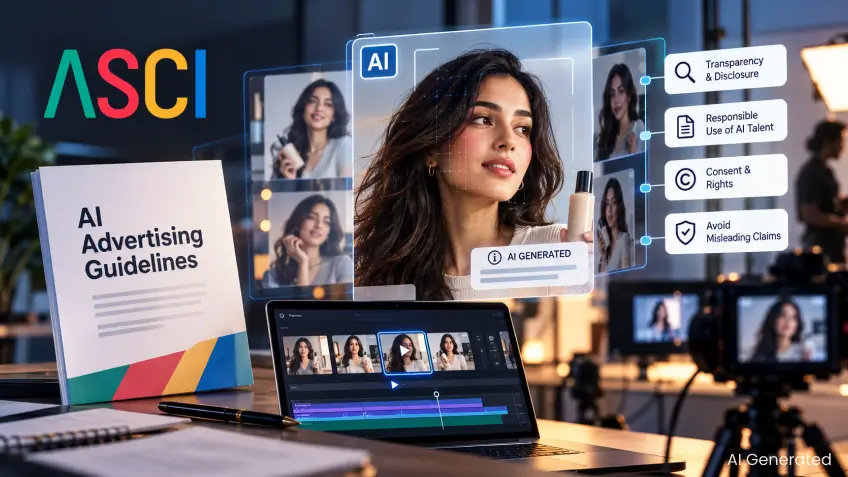


AI-generated faces are rapidly becoming commonplace in Indian advertising. These faces can be seen in fashion catalogs, home loan advertisements, regional videos, and social media campaigns. However, the individual depicted may never have actually been filmed. While this may not necessarily be problematic, it does raise a significant question: where do we draw the line?
On September 17, 2026, the Advertising Standards Council of India (ASCI) released its Guidelines for Responsible Labelling of Synthetically Generated Content in Advertising. The guidelines will take effect three months after their release date, which will be approximately mid-December 2026.
For brands and agencies utilizing AI in advertising, it is essential to understand these guidelines now rather than after a campaign has gone live. There are essentially two aspects to consider.
First, what can you do with AI in advertising, what needs to be disclosed, and what is prohibited? Second, if you wish to utilize AI-generated individuals in your advertising, how do you do so appropriately?
One practical approach is to work with real talent, obtain their permission to use their likeness, and then use AI to generate the content.
The guidelines apply to what ASCI refers to as synthetically generated content. In simple terms, synthetically generated content refers to audio, images, or video created or significantly altered using AI, where the final product appears sufficiently realistic for a person to believe that the individual or event depicted is genuine.
The primary consideration here is not the technology employed, but rather whether the consumer is being misled. If AI is employed in a manner that misrepresents a product, exploits individuals, creates a false impression, or utilizes someone's likeness or voice without authorization, then there is an issue.
ASCI considers three broad questions when determining whether AI-generated content requires labelling
- Is the AI-generated content a significant component of the advertising message or does it influence the consumer's purchasing decision?
- Could the consumer be misled about the product, its performance, or its benefits if the use of AI is not disclosed?
- Would failing to disclose the use of AI create a false impression? And, of course, using AI does not exempt you from complying with the normal ASCI Code. The advertising must still comply with the Code.
This is an important distinction.
Adding an "AI-generated" label to something does not make misleading advertising acceptable. The following uses can still violate the ASCI Code:
| Use | What It Means | Clause |
|---|---|---|
| Fake endorsements | Depicting a real person using, endorsing, or recommending a product/service when they have never actually done so | 1A |
| Exaggerated results | Using AI-generated visuals (e.g., before-and-after images) to demonstrate results that the product cannot actually achieve | 1B |
| Places or facilities that do not exist | Depicting a hotel, location, or facility as real when it is not | 1C |
| Using someone's likeness without permission | Using a person's face, voice, or copyrighted work without obtaining the necessary authorisation | 1D |
There is an important difference between making an image look better and creating a false impression.
Normal things like colour correction are not the issue. The problem starts when the AI-generated or altered visual makes the consumer believe the product can do something it actually cannot.
There are also instances where you may use AI, but you must inform the consumer about it.
This occurs when the AI-generated content has a material impact on the consumer's understanding or decision-making process.
| Use | Example | Clause |
|---|---|---|
| AI influencers and brand ambassadors | A completely synthetic influencer promoting a product | 2A |
| Real people recreated using AI | Creating personalized messages using a real person's face/voice, even if they have granted permission | 2B |
| Invented scenes or events | Creating a scenario that alters the consumer's perception of the product's performance | 2C |
| Products that do not exist yet | Generating a visual of a housing development project that has not yet been constructed | 2D |
| AI sound linked to the product | Generating audio using AI to demonstrate the audio quality of a headset | 2E |
| Sponsored AI recommendations | A chatbot recommending a product because the brand has paid for the recommendation | 2F |
ASCI has suggested labels such as "Audio/Video created using AI" and "Audio/Video enhanced using AI". Brands may use their own terminology or a platform's label, provided it clearly informs the consumer what they are viewing.
For sponsored AI recommendations, the disclosure must state "Sponsored by [Brand]".
This is where the guidelines are quite practical. Not every use of AI requires a prominent disclosure. If every use of AI required a prominent disclosure, we would soon have labels everywhere and consumers would simply ignore them. ASCI states that many routine uses of AI do not require disclosure when they do not alter the advertising claim.
These include:
• Minor enhancements: colour correction, lighting adjustments, noise reduction, normal blemish removal, formatting and copy refinement.
• Background elements: decorative backgrounds, abstract skylines, ambient music, jingles and crowd sounds that have nothing to do with the product's actual capability.
• Obvious fantasy: for example, a fairy fixing a product with magic dust or a car turning into a spaceship. If nobody could reasonably mistake it for reality, it is treated differently.
• Administrative and text-related uses: AI-written advertising copy, documents prepared in good faith and similar uses.
• Accessibility: subtitles, closed captions, translations and accurate audio descriptions.
But there is one thing to keep in mind.
A label alone does not make an advertisement acceptable. An AI-generated advertisement can still be misleading even if it contains a disclosure.
This is likely the aspect of the guidelines that brands and agencies should focus on more.
ASCI is not banning AI-generated individuals. What it is doing is placing consent at the center of the issue. If you use someone's face or voice without their permission in an advertisement, that is an issue.
If a real person agrees to allow you to use their likeness and the agreement is properly documented, then the situation is significantly different.
The basic concept is relatively simple. Instead of asking AI to generate a random individual who happens to resemble someone, begin with a real person who has agreed to allow you to use their face and voice. You then use AI to generate multiple versions of the content based upon the terms that have been agreed upon.
This provides you with the speed and flexibility of AI while also having a real person, a contract and a record of consent behind the work.
| Generic AI Image | Licensed AI Image | |
|---|---|---|
| Consent | None | Signed licence |
| Look-alike risk | Unknown | Known, contracted person |
| If there is a complaint | No consent record | Consent on record |
| Real talent paid | No | Yes |
| Speed and cost benefits of AI | Yes | Yes |
Both types of AI-generated content may require an AI label depending on how they are used.
The key difference is that with licensed talent, you can demonstrate where the likeness originated from and that the talent agreed to it.
The process is very similar to a standard casting process. There are simply a few additional factors to consider.
• Define the brief Determine what you require. Age, appearance, languages spoken, type of individual and most importantly, where the content will be utilized.
• Locate the appropriate talent You can utilize a talent platform or work with a casting director/agent.
• Establish the license agreement This is arguably the most critical step. The use of AI should be explicitly stated in the contract. It should not be something you decide to include later.
• Capture the likeness The talent must be photographed, filmed and/or recorded for voice in a controlled environment with their explicit consent.
• Generate the content using AI Once the license agreement is established, AI can be used to generate various versions of the campaign based upon the agreed-upon terms.
• Label the content where applicable If the guidelines require a disclosure, include it. For example, "Video created using AI".
• Maintain documentation Retain copies of the license agreement, consent records and approvals. If someone files a complaint six months later, you do not want to begin searching for documentation at that point.
At a minimum, the agreement should clearly define:
• Where the talent's likeness can be used
• Which platforms and media are covered
• The geographic area(s) covered
• The duration of the license agreement
• Payment terms and renewal options
• What the AI version of the talent can and cannot say/do
• Whether the talent has approval rights over the final product
• How photographs/videos/other data will be stored
• What happens to data once the license agreement expires
• Whether the talent can withdraw consent and how much notice is required. This is one area where it is advisable to consult with an attorney.
This article provides guidance; it is not legal advice.
There are several methods for finding talent.
Talentrack is one method. It is a talent/content marketplace established in 2015 that lists artists across various categories including actors/models/anchors/voice-over artists. It also provides casting/production services.
Disclosure: Talentrack is a partner of Nine Triangles.
Other options include:
• Online casting platforms: Casting Bell, for example, connects actors with recruiters across films, OTT and advertising, with filters for things such as age, language and location.
• Casting agents and casting directors: Particularly useful when you are looking for a specific kind of person, regional talent or help with negotiating the licence.
• People you have already worked with: A brand ambassador or model from an earlier campaign may be open to an AI likeness arrangement. You would still need a new agreement that specifically covers AI use.
Whatever route you take, get the person's agreement to AI use in writing before collecting their photographs, video or voice data.
Finding the talent is only one part of the job.
You also need a production partner that understands both AI and the advertising side of things.
There are several agencies and production companies in India working with AI-enabled production.
| Agency | What they offer |
|---|---|
| Nine Triangles | A hybrid creative, technology and media agency. It can manage the process from talent contracts and licensing through AI production and labelling. |
| Omnicom Production | Omnicom's content and production engine, including scaled and synthetic content using AI-powered tools. |
| WPP Production | Launched in February 2026, |
With strategy and insights at the core, we seamlessly integrate creative, technology, video, SEO, and performance marketing to deliver projects on time and within budget. That's why clients of all sizes and industries trust us for their most diverse and dynamic needs.



















We combine the agility of a mid-sized agency with the strategic depth of a consulting partner. Every project starts with a business lens - focused on outcomes, not just outputs.
In short, we are not just a digital agency. We are your digital growth partner.
We are all three - by design.
Our model is built to support modern business needs through integrated services across strategy, design, technology, and performance marketing. We help you define the problem, build the solution, and scale the impact.
We complement, not compete.
Think of us as your extended team - brought in for specific expertise, overflow capacity, or to scale faster. Whether it is UX strategy, campaign content, full-stack development, or performance marketing, we plug in where it matters most.
We work across markets and time zones.
Our teams are based in India, but we have delivered for clients in the Middle East, Europe, the US, Southeast Asia, and beyond. We adapt our workflows to suit your region, your rhythm, and your goals.
Simple - just reach out.
We will begin with a conversation to understand your needs and identify how we can support you. From there, we tailor the right approach - whether it is a quick sprint or a long-term roadmap.
© 2026 All Rights Reserved