2023 Artificial Intelligence: Benefits of AI for Digital Marketing
17 Mar, 2023

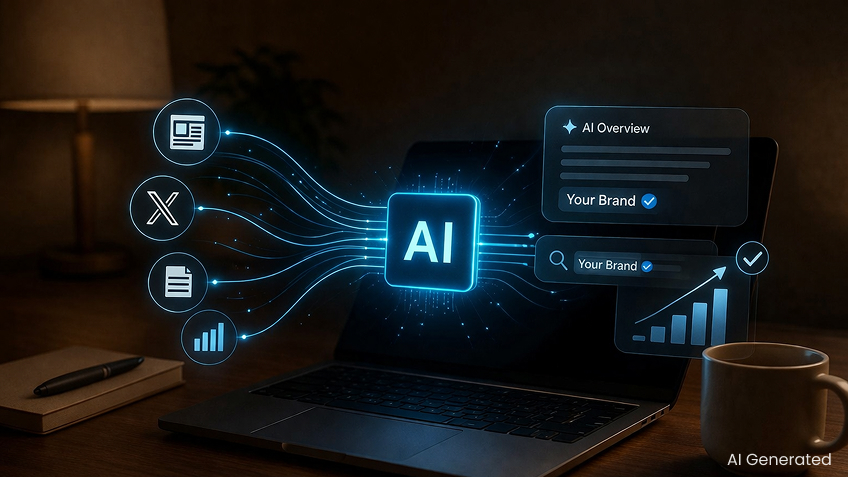


Search has changed, and brands that didn't notice it yet are already losing market share.
As per Loopex Digital’s 2026 analysis, Google AI Overview has featured 47% of all queries. Organic click-through rates have decreased by 61% for queries with AI Overviews. Position Digital's Q1 2026 report reveals 37% of consumers search with AI instead of traditional search engines.
In short, customers are increasingly getting their responses through ChatGPT, Gemini, Perplexity, and Google AI. Brands that don't appear in such responses miss an increasing proportion of high-intent searching groups.
AI visibility is booming, and these are the 8 most effective strategies you can utilize for your business.
The major change in AI search optimization is the shift from searching and targeting keywords to covering topics in detail. AI platforms don't do keyword search but check that your content fully answers the question.
Simple content that thoroughly covers the topic gets ignored. Citations are made of deep answers. For topical depth:
- Fully address the question
- Develop subquestions and follow-up questions.
- Have professional authority based on personal experience.
- Provide evidence on claims using data, case studies, and real examples.
- Give explanations and logic to the content with bullet points.
- As you provide detailed answers, AI systems will consider you a source.
AI systems often overlook even detailed content when they cannot discover and read it. Structure is not just good for human readers. It is also a fundamental requirement for AI-driven search ranking.
Use headings with descriptive H2s and H3s to clarify what each section contains. Limit paragraph length to four sentences or less. Include a Q&A section. AI systems always prefer the question-answer format since it’s the way people engage in AI platforms.
Schema markup is arguably one of the most direct signals you can give to AI systems about your content and how it is supposed to be understood.
In its absence, you rely on AI for your content structure by directly conveying relevance, authority, and contextual information about the topic. The most important types of schemas to focus are:
- FAQ Page schema: It directly feeds People Also Ask and AI Overview features
- How To Schema: This is best suited for step-by-step instructions and tutorials.
- Article schema: Includes date, authority, and topic information.
- Local business schema: Necessary when brands are targeting local geographic markets.
AI platforms are biased toward credible sources full of expertise and trustworthiness. Sometimes AI responses systematically demote even authoritative content.
According to Superlines' research, content with statistics, citations, and quotations achieves 30–40% higher visibility in AI search results than content without authority.
Practically Include authority in every piece of content to show verifiable author bios, references to an external source, real data and case studies, testimonials and reviews from clients, and links to industry recognition or certifications where applicable.
AI models are trained on data sets and always prefer updated content over pages that have not been updated in months. You don't have to rewrite it all. You can:
- Replace old statistics with the latest and authenticated ones.
- Add new examples and case studies indicating recent trends.
- Updates publish dates if major edits are added.
- Regular content updates are great improvements in AI visibility strategies.
Generative Engine Optimization, also known as GEO, is the practice of writing human-like content using AI tools so that you give answers and are referenced in conversational AI responses.
GEO is one of the most direct ways to improve the AI visibility of your brand. Write in an ordinary, conversational tone rather than a formal tone. Expects follow-up questions and responds to them with the same content. Write with simple sentences, clear transitions of topics, and organized responses.
Imagine that all the content is an answer to a query presented by a user. In AI searches, this is actually true.
It is impossible to reference content that you cannot read. A significant number of brands are preventing AI crawlers unintentionally by corrupted robots.txt files, heavy JavaScript-based rendering or server-side restrictions that block pages. These things needed to be verified and improved:
- Ensure GPTBot, CCBot and other AI crawlers are not blocked in your robots.
- Make important pages load without running JavaScript.
- Keep page loads as fast as possible; content that loads faster is cited.
- Include sitemaps and canonical tags.
- Use HTTPS as a security indicator. It affects AI trust scores.
AI systems don't just analyze your website. They integrate data from across the web, and brands that emerge throughout the reputable media have more citations.
YouTube mentions and branded web mentions are strongly correlated with AI visibility of any external signal compared to traditional counts. Things you can do are:
- Get coverage from reputable publications and news companies in the industry.
- Publish guest posts that create real value for the targeted audiences.
- Post on websites frequently visited by AI algorithms: Reddit, Quora, LinkedIn, and forums.
- Seek podcasts, communities and third-party recommendations.
- Always keep a consistent voice and message throughout all the platforms where you’re featured.
AI search optimization does not come with a specific strategy. It is a comprehensive road map for content, technical SEO, authority building, and GEO to ensure your brand becomes trusted in AI platforms.
Nine Triangles is a strategy-led digital agency with three integrated labs—Creative, Technology, and Media—and deep expertise in AI-powered SEO services, performance marketing, content strategy, and search optimization. With 8+ years of experience across the globe, with clients such as ICICI Bank, Aditya Birla Capital, and more. We aim for consistency in every engagement to achieve data-driven results.
Nine Triangles implements all AI visibility strategies in this guide as one integrated approach via AI SEO and technical optimization, content creation, and brand authority building.
The future of search lies in AI visibility, and the difference can be seen between brands that are already tuned to it and those that are not.
These AI visibility strategies are most effective right now—across AI platforms. Brands that continue using them are able to establish a sustainable presence in AI-generated responses.
Today, there is an open opportunity to get AI visibility organically. It’s not going to remain the same.
Query fan-out is the situation in which AI is expanded to generate related queries simultaneously as part of a search. Brands with high topical authority in related topics are more likely to receive mentions than those who focus on keywords.
Yes, traditional SEO is still important as AI visibility is created on top of traditional SEO, which is based on technicality and authority.
No, AI platforms prioritize multiple aspects: Gemini for E-E-A-T, Perplexity for structured citations, and ChatGPT for general web signals. It is best to keep a balanced approach.
Technical improvements may drive results in weeks, whereas content authority generally takes 1-3 months. It is not a one-time effort.
With strategy and insights at the core, we seamlessly integrate creative, technology, video, SEO, and performance marketing to deliver projects on time and within budget. That's why clients of all sizes and industries trust us for their most diverse and dynamic needs.


















We combine the agility of a mid-sized agency with the strategic depth of a consulting partner. Every project starts with a business lens - focused on outcomes, not just outputs.
In short, we are not just a digital agency. We are your digital growth partner.
We are all three - by design.
Our model is built to support modern business needs through integrated services across strategy, design, technology, and performance marketing. We help you define the problem, build the solution, and scale the impact.
We complement, not compete.
Think of us as your extended team - brought in for specific expertise, overflow capacity, or to scale faster. Whether it is UX strategy, campaign content, full-stack development, or performance marketing, we plug in where it matters most.
We work across markets and time zones.
Our teams are based in India, but we have delivered for clients in the Middle East, Europe, the US, Southeast Asia, and beyond. We adapt our workflows to suit your region, your rhythm, and your goals.
Simple - just reach out.
We will begin with a conversation to understand your needs and identify how we can support you. From there, we tailor the right approach - whether it is a quick sprint or a long-term roadmap.
© 2026 All Rights Reserved
.jpg)